Showing posts with label Spanish Culture. Show all posts

Monday, April 23, 2012

Qué F*ckin Rico

I realized recently that I haven't really written about Spanish food here on this blog. Weird, considering how important food is to Spanish culture, and how much I like to eat. There is far too much material to cover in just one entry, so I'll start with some basics. 

Most importantly: contrary to what I have been asked by many Americans, Spanish food is not spicy. In fact, most Spanish people I know are babies when it comes to spicy food. Put a little black pepper in there and shouts of Me pica!! will resound. Nor does Spanish food include things like burritos, tacos, or fajitas. That is Mexican food. Just because they speak the same language (sort of) doesn't mean their food is even remotely similar. Please think of American food being compared with British food the next time you feel tempted to ask a Spaniard if they prefer chicken or beef tamales with their frijoles. 

With that out of the way, here is the rundown on Spanish meals:

First comes breakfast, which is a small, fast meal, often eaten at a bar on the way to work. Most adults have coffee and a few cookies. Yes, cookies. Kids have Colacao, which is a brand of chocolate milk drunk either hot or cold. In the morning kids drink it hot, and cannot imagine having anything else. When we went to London with students my first year here, a kid asked me if they had Colacao in London. I said probably not, but they might have another brand of chocolate milk. He was horrified. "No Colacao?? What do they drink?! I'll have to bring my own!!" Kids will have cookies too, normally, or a piece of toast or cereal.

Mid-morning people usually have a light snack. Kids bring a bocadillo or grinder/sandwich to school to have during their break, which normally consists of bread and some type of cured meat -- details on those later, the cured pork products in this country warrant their own entry -- or nutella. Adults have another coffee, and maybe a pintxo/pincho/tapa -- again, more on these in another entry -- at a nearby bar. 

Sometimes, especially on weekends, there is another intermediate meal before lunch. I believe it's normally when you've stayed out late and slept through breakfast time, so people often meet friends at a bar around noon or 1pm for el vermút, literally "the vermouth". Some people drink vermouth, but mostly it's another chance to meet friends and have a little pintxo and a beer before the big lunchtime meal.

The main meal is lunch, which is around 2 or 3pm. In fact, the "morning" lasts until after everyone has eaten. That took a little bit of adjusting to when I first arrived -- to remember that 1pm is still the morning here. Anyway, lunch is always at least two courses, plus dessert and coffee afterwards. If you go out to eat, a common option is a menú del día, or "menu of the day" which is a set menu that most restaurants offer at a fixed price. Every day is different, but you choose from three or four first courses and three or four second courses, with dessert, coffee, bread, and wine or water included. You can spend up to 20euro, but a normal price is between 9 and 15. I'll try to post typical menus I see so you can get an idea of what types of food they offer, but typically the first course is salad/vegetables, soup, or beans/chickpeas/lentils. Most places will have fish, chicken, and red meat options for the second course. Dessert can be cake, flan (custard), etc., but I normally ask for fruit. Which is always available but not too common to order in restaurants, so I am often served an entire orange on a plate, with a knife and fork. Then coffee -- espresso -- which I drink black. Believe me, when you have to go back to work for another four hoursafter such a big meal you need that caffeine boost to get you through the afternoon.

Other (faster) lunch options at restaurants include sandwiches (pronounced SAN-weech-ess), which are always multi-layered and fried on the grill, and can include ham, cheese, a fried egg, white asparagus, lettuce, tomato, tuna, and lots of mayonnaise. Or you can get a plato combinado, combination plate, which will have several options in the style of Chinese lunch specials in the States -- the serving style, not the food style -- like croquettes, salad, hot dogs and french fries, or a grilled chicken breast, salad, mini empanadas and french fries, etc.

At home, most lunches are like the menu of the day, with a few courses. For example, Sunday I had lunch at my choir director's house. We had chicken noodle soup to start, followed by green beans with mushrooms, ham, tomato and garlic. Then as a main course we had oven-roasted chicken thighs with garlic and potatoes. Dessert was fresh strawberries with whipped cream, then coffee, and I think the other adults had a chupito or shot of orujo, a typical Cantabrian liquor that can be flavored with honey, cream, mint, etc. This was a weekend meal, though, so I imagine it was slightly fancier and more time-intensive than a mid-week meal.

Alcohol is typical at the lunchtime meal, but by no means required. It is perfectly normal to order wine or beer with your meal, and wine is included in the menú del día. But be careful -- the wine included in the menú is an entire bottle, so if you're by yourself you will go back to work drunk. 

And bread. Bread is a huge part of every lunchtime meal. Most people cannot imagine a meal without bread, even if they're also having rice, pasta, or potatoes. And it's perfectly acceptable -- even expected -- for you to put your bread right on the tablecloth above your knife and spoon, not on a separate bread plate. I used to give class to a five-year-old boy, and the way the schedules worked out I would wait for him to have lunch before we had class. His grandmother was adamant about teaching him table manners, which for her -- and most Spanish people -- included holding a piece of bread in your left hand and using it to scoop food onto your fork, held in your right hand. My grandpa Twig is rolling over in his grave as I write this -- bread on the table at a meal, directly on the table, and being used to mop up food?!  

Merienda, or snack time, is around 6 or 7pm, and is something small to hold you over until the very late dinner hour. Merienda can be another bocadillo like the kids bring to school for snack, or some fruit and cookies, or for adults, coffee and a piece of pound cake. It's quite common to meet family or friends on weekends for a merienda, and if the weather's nice people sit outside and snack while the kids run around and play. This meal can often involve alcohol as well.

Dinner is a lighter meal, eaten at 10 or 11pm, just before going to bed. It can include soup, salad, a sandwich, or even the delicious tortilla española, which is often translated as "Spanish omelette," but it's so much more than an omelette. It's a thick, potato-and-onion-filled egg dish, kind of like the Italian fritatta. It's eaten with a big hunk of bread on the side, and can be plain or topped with anything from tomato to tuna salad to ham and cheese.

In general Spanish cooking is very respectful of the ingredients: the meat, fish and vegetables are usually quite fresh and of very good quality, and cooks don't use a lot of fancy spices. It's a running joke among my friends that the only Spanish spices are salt, pepper, garlic, parsley, and paprika. Which is pretty accurate. And pretty delicious.


*Regarding the title of this post. Qué rico! Means "How delicious!" My lovely friend Francesca used to say, in her imitation of the absolute worst American-speaking-Spanish accent, "Que f*ckin rico." And it's all soooo f*kin rico.

Friday, April 20, 2012

Go to...

Instead of saying "Go to hell," the Spanish say "Vete a tomar por culo," which means "Go take it up the ass." Lite versions include "Go take it in a sack" (?).

This blog is getting out of hand. 

Edit: another lite-but-not-so-lite version I remembered over the weekend (because I heard it) is vete a la mierda which means "Go to the shit." 

Monday, April 16, 2012

Me cago en...

Let's start off this series with a doozy. Perhaps the most offensive Spanish curse is "Me cago en Dios," which means, literally, "I shit on God." To soften this rather fuerte (shocking) imagery, there are lots of substitutions for "God". Think that middle-school replacement of saying "sugar" when you want to say "shit." (Here they say miércoles [Wednesday] when they want to say mierda [shit].) When you want to shit on something other than God, the options include: 

Me cago en...                                          I shit in/on...
 ...la leche                                                ...the milk
...la mar                                                  ...the sea
...diez (sounds like Dios, god)                ...ten 

And should you want to make "I shit on God" even more offensive -- didn't think that was possible, didja? -- you can say Me cago en tu puta madre, which means "I shit on your whore mother." 

On that respectful, loving note, I'm signing off.

An Introduction to Spanish Cursing

The Spanish love to curse. Here, children as young as four, five, six are saying words that, in English, would make anyone blush and would warrant a rebuke, if not a spanking. Ass, shit, fuck, and even the C-word are ubiquitous, and nowhere near as offensive as in English. Grannies on the street say the C-word when they drop their shopping bags. My eight-year-old students say shit when they make a spelling mistake. Even the most boring, quiet class snaps to attention when the conversation turns to how to curse in English. It's actually pretty interesting to think about how swears have evolved in each language, and how different words are used to convey the same meaning. For example, to call someone a bitch, they don't use the word for female dog as much as they use the word for female fox (zorra). To say "son of a bitch" they say "son of a whore".

Pronunciation is also key here: one of the hardest distinctions for Spanish speakers to make is between dark and light vowels in English. Spanish has the same five vowels as English, but each one has only one sound that it always makes. None of this wind/wind or live/live confusion. I can't count the number of people who have confided to me that they're afraid to talk about going to the beach because they're afraid they're going to say bitch instead. My sophomores last year giggled uncontrollably when I handed out "worksheets" -- that small but oh-so-important difference in vowel sounds made it sound to them like I was saying "workshits". Ha ha, "shit" is soooo funny when you are fifteen.

Spanish curses can be quite creative, and when translated they're pretty funny. And so begins a new series: Spanish Swear of the Day. (Although let's be honest, daily here is a very high expectation for me and it will more likely be bi-weekly or even weekly or even monthly if we are very, very honest.) 

Monday, April 2, 2012

In Which I Find Myself Protesting

I found myself getting roped into a (what turned into a very peaceful) protest march Thursday morning...

My day began with this. See that lovely mint green building in the background? Yeah, that's where I live.

The smoke I smelled upon waking up in the morning turned out to be from a plastic dumpster -- previously filled with paper -- that had been set on fire. There were lots of (young, cute) policemen hanging around looking important, but also a bit nervous. This was strike day, everyone knew it, and apparently things were beginning like the peaceful-turned-not-so-peaceful protests in Valencia and Barcelona from earlier in the year.

Later that morning my friend Sheila texted me saying she was coming to the protest, and asked if I wanted to meet up for a visit before she went to the gathering at the ministry building. I hadn't seen her in a while, so I went, thinking we would just chat for a bit. Until she told me that, should I ever want to stay in her cute new apartment when I visit, I should go to the march. So I thought about it, and decided to go.

First thing in the morning, picketers were posted outside various ministry buildings and factories. At mid-day there was the march "in defense of public education", and later in the evening there was a more labor-oriented protest, that ended up gathering about 80,000 people, making it the biggest protest march in Santander's history. There were some scuffles between picketers and ministry workers, and some more violence during the major afternoon protest. But the march for education was totally peaceful: teachers, parents, and students, walking through the city. There was some yelling and some noise cannons, but mostly there was lots of camaraderie, and everyone seemed to know everyone else there. I think I ran in to about 85% of the people I've met here in the last four years. The afternoon protest, though, did get more violent (it even made the BBC!) .  I stayed in my little attic home for that one, and listened to the noise cannons from far away. "Violent" meaning there was lots of pushing and yelling. In Torrelavega, where I work, a lady got slashed with a big ol' knife -- wielded by a hotel owner with a history of assault. It was not as violent as it could have been, by any means; but neither was it as peaceful as it could have been.

At first I felt funny about going to a protest in a country that's not my own; hell, I probably wouldn't even go to one in the US. But then I got to thinking about what happened to me back in October. Turns out, I am directly affected by all these education reforms. At the moment I have no visa and no health insurance because of the new government. But that's not the only reason I went. I love this place, this city, the people I've become close to here. Most of my friends are teachers; I adore my students in private classes, the academy, and the school where I used to work. These reforms will affect them every day for the rest of their academic lives. The reforms will affect my teacher friends for the rest of their working lives. The Spanish use the word solidarity a lot more than we do; I think it's something that should be incorporated more fully into the American vocabulary. So that's why I went: for my own rights, but also, and I think, more importantly, for the rights of the people I love here who I think are being treated unfairly.

Since When Do I Write About Politics?

Last Thursday (March 29) was a "huelga general" here in Spain, meaning the various unions called for a nationwide strike -- and protest march -- across all sectors. Now, if you're anything like me, you haven't been following the political reforms in Spain very closely, which is fine for you, but not so great for me considering I live here. I haven't done any detailed research, but have talked to lots of friends about it, and generally the attitude is "La cosa está muy mal. Muy, muy mal." ("Things are bad. Very, very bad.")

There have been a number of budget cuts in education, and since the majority of my friends here are either teachers or graduate students, I hear anecdotal news quite frequently. I also watch the news every morning and sort of pay attention to what's on in between weather reports. AND I read the newspaper at the cafe with the little awkward waiter when I have coffee there a few times a week. So I guess I do keep up on the news...kind of...anyway, the problems in education. For example: this winter in Valencia students went on strike when the heat was shut off in their classrooms because the school hadn't received funds during the entire school year. They protested in front of the school, and things escalated quickly to violence between riot police and protesters. The general feeling was that a small group of radicals took advantage of the situation and started setting things on fire, while the students had been calling for (and enacting) a peaceful protest all along. More on that in a minute.

All over the country, faculty jobs are being reduced while teachers' working hours are being increased, as are class sizes. That means fewer teachers who are more overworked -- and who are mostly burnt out, since the young teachers without fixed positions will be the first to get the axe -- with more students, all of whom are there for more hours. In what world does that sound like a good idea?

The new (conservative) government, who won the elections earlier this year, have also made big changes in the labor laws. Women may now be fired if they become pregnant, which some people say is effectively encouraging (if not requiring) them to abort. In these times of 25% unemployment (a figure that rises to 48% if you are under 25 years old), some people seem to think that terminating a pregnancy would be better than losing your job. Companies/bosses now have what seems like ultimate power to fire anyone they want to, for any reason they want to. I have heard (totally anecdotal, I don't know how reliable these stories are) that people have lost their jobs for taking justified leave -- that is, my daughter's in the hospital, I have a doctor's note because I have been having chemotherapy, I broke my leg and had to miss a week of work.

There was lots of hype surrounding this general strike, and most people I talked to said they were going to participate. I think that's just great -- the strike was planned in advance, employers had notice, and people could make their own decisions as to whether or not to go to work. But the more people I talked to, the more perspectives I got. The mom of two kids I teach in a private class works in an until-recently-family-owned manufacturing company. She said none of the workers wanted to strike, because they wanted to be paid for that day. But because they were bodily afraid of picketers -- most of whom came from other provinces so that they wouldn't know or be recognized by anyone they were antagonizing -- they opted to take a vacation day and close the factory.

Now, I take that report with a grain of salt -- because what worker is always completely 100% honest with their bosses about wanting to strike? But that they were afraid for their physical safety if they chose to go to work...doesn't that defeat the purpose of striking to begin with? Isn't the whole idea that people be allowed to exercise their right to strike -- or not? It's unfair and hypocritical that people would travel to other provinces to intimidate people into not going to work, when they are exercising their rights just as much as the picketers. That's the cool thing about a democracy -- at least about the theory of a democracy -- I get to express and act upon my opinions, and so do you. As long as they're not hurting anyone else, it's OK. Now leave me alone about it.

I never meant for this to be a political blog, and I think I can safely say that it has not become so, based on the fact that my last three posts were about music, bugs, and a long-and-involved personal story that I'm not sure anyone even read. Nor have I ever considered myself particularly politically-inclined, especially when it comes to protesting and marches and other scary things that involve big crowds of people and riot police. But after hearing all these stories about the political situation in Spain, I ultimately decided to participate in one. Details to follow.

Friday, March 9, 2012

Wherein a Waiter Makes my Day (in a good way, not in the Clint Eastwood way)

I always go to the same cafe for a coffee when I have a break between jobs. It's right downstairs from the English academy where I work, and it has a terrace in front of the ancient town hall, and the people are nice, and the coffee is cheap(ish). (Side note: here, "Tomar un café," or "Have a coffee" is often a euphemism for going to a bar to drink/eat something and chat. I regularly enjoy this Spanish ritual and don't know how I will cope once I have to move back to the espresso-less United States).

Last Friday I went at kind of a weird time: it was too late for the after-lunch coffee, and too early for the evening-snack-coffee, so there was no one outside on the patio where I chose to sit. It was a little chilly, but I had to take advantage of the late-afternoon sunshine as much as possible before returning to work. It took a while to get waited on, which is slightly unusual at this place. Maybe since I was the only one outside they didn't realize I was there. In any case, I'd put my headphones in to listen to my audiobook before they brought me a newspaper to read, so I was startled when I saw something out of the corner of my eye. Thinking all manner of bag-snatching, loogy-hawking, kleenex-selling street people were watching me, I turned around. There, in his fuschia sweater-vest, was the bald, cross-eyed, snaggle-toothed waiter who is always so very nice to me, an espresso in a doll-sized cup balanced in his hands like an offering.

Me: (laughing in surprise) "Is that for me??!"
Awkward cute waiter man: (with a small, slightly embarrassed smile) "Yes, of course, if you want it." 

Of course I accepted; I always order the same thing there, and they know me. This only served to hammer that home. It felt so nice to be included, known, and paid attention to. A part of a mini community in a bustling city. But every time something like this happens it breaks my heart a little bit. Because I am reminded how painful it will be when, someday, I have to leave it all behind.

Friday, February 24, 2012

A Weekend Adventure

A few weekends ago I went to Asturias, the next province to the west of Cantabria, with some friends on a little day trip. We went to see a cave called el Pindal, which full of paleolithic paintings. These included depictions of a fish and a mammoth, which are very rare in cave paintings in this area, if you were wondering. But I suppose I should talk about this day chronologically, so you will have to wait a minute til I get to the cave part (or scroll down, if you are that excited about paleolithic cave art. That's you, mom.)

First we stopped for lunch in Cerrazo, a tiny, typical Cantabrian village near Torrelavega, the city where I work. The restaurant is really popular because it's a) cheap, and b) has great food, and they don't take reservations, so we got there a little early...so early, in fact, that the kitchen wasn't open. That's ok, we'll just go for a nice stroll through the village. Now I should mention that EVERY. TIME we leave the city I make a huge annoying point of going to find ponies, because there are inevitably some pastured nearby. My friends are very good about humoring this particular quirk of mine. I even have a "pony kit" ready to go, which I have never once remembered to bring along. It includes two brushes, one hard, one soft (I bought them at the supermarket and I'm pretty sure they were meant for shoe cleaning), a sugar cube stealthily stolen from a bar, and a carrot. Well, actually, the carrot is in there on kind of a rotating basis, because they were getting all shriveled up and smelly between pony excursions.

So we walked down the hill from the restaurant, and sure enough! We found two horsies in a beautiful field. The seemed pretty uninterested in us, though, and my friends were ready to continue along the country lane. "Oh pish posh," I said. "Let me show you a little pony trick I know." I pulled out a packet of kleenex from my bag and wrinkled the plastic wrapper. This method is not very honest, because it makes the pony think he is going to get a peppermint or other similarly cellophane-wrapped treat. But it is a tried-and-true way of luring ponies closer to fences to be petted. And this proves its effectiveness is international. Sure enough, this nice, dirty, stocky grey pony lumbered over, ears perked up and looking for a candy. I apologized for tricking him but soon learned he felt pretty OK about it, and was happy to be scratched and patted. My friends were very shocked at this: what can I say, my horse powers are finely tuned. They even called me the horse whisperer! We spent a little while with this nice fellow, and my friends found it hilarious that he was pretty lippy, meaning he let me play with his nose and he made funny faces and yawned big great yawns, and let me kiss the soft, velvet spot between his nostrils. My friends eventually got a little bored (I would happily have stayed there all afternoon), so we continued up the road. This is our parting glimpse of my pony friend:

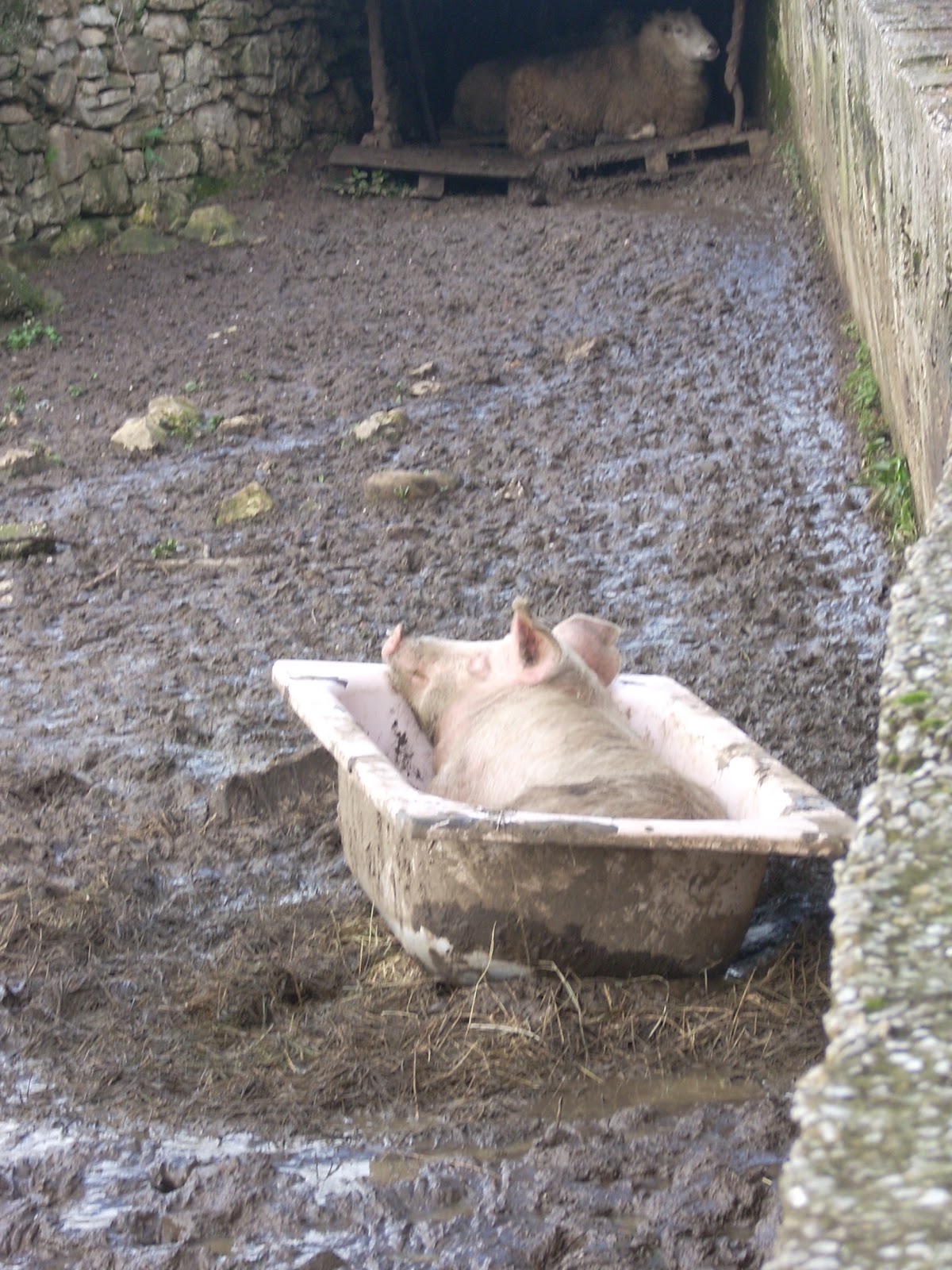
As we walked along we passed a few farms, and one had a big, muddy pen in the back yard. We found some sheep huddled in a shed, looking stranded in a sea of muck. And in another such refuge:


He/she is destined, I'm sure, to be chorizo, jamón, lomo, or salchichón one day. Such is the life cycle of a Spanish pig. 


We went back up the hill and had a lovely lunch -- I'll do an entry on food later on, so you can get familiar with all the jargon -- including raciones of morcilla (blood sausage, don't you turn your nose up, it is delicious), piping hot clams with olive oil, garlic, parsley, and hot peppers, and a cheese plate. For our main course we split a whole white fish cooked in the oven with potatoes, tomatoes, onions, and peppers, and a steak with french fries and roasted red peppers. I didn't eat much steak, not being a big red meat person, and especially not being a very, very rare red meat person. But I can appreciate the quality and preparation of the meat here, especially this steak. It was cooked on a super hot grill with nothing but salt and maybe a little oil. Everything was spectacular. Spanish food really is great. To drink I had a glass of red wine, one friend had a beer, and we all had water and mosto, a very sweet grape juice made as a bi-product of (? or maybe just in the same facility as) wine.

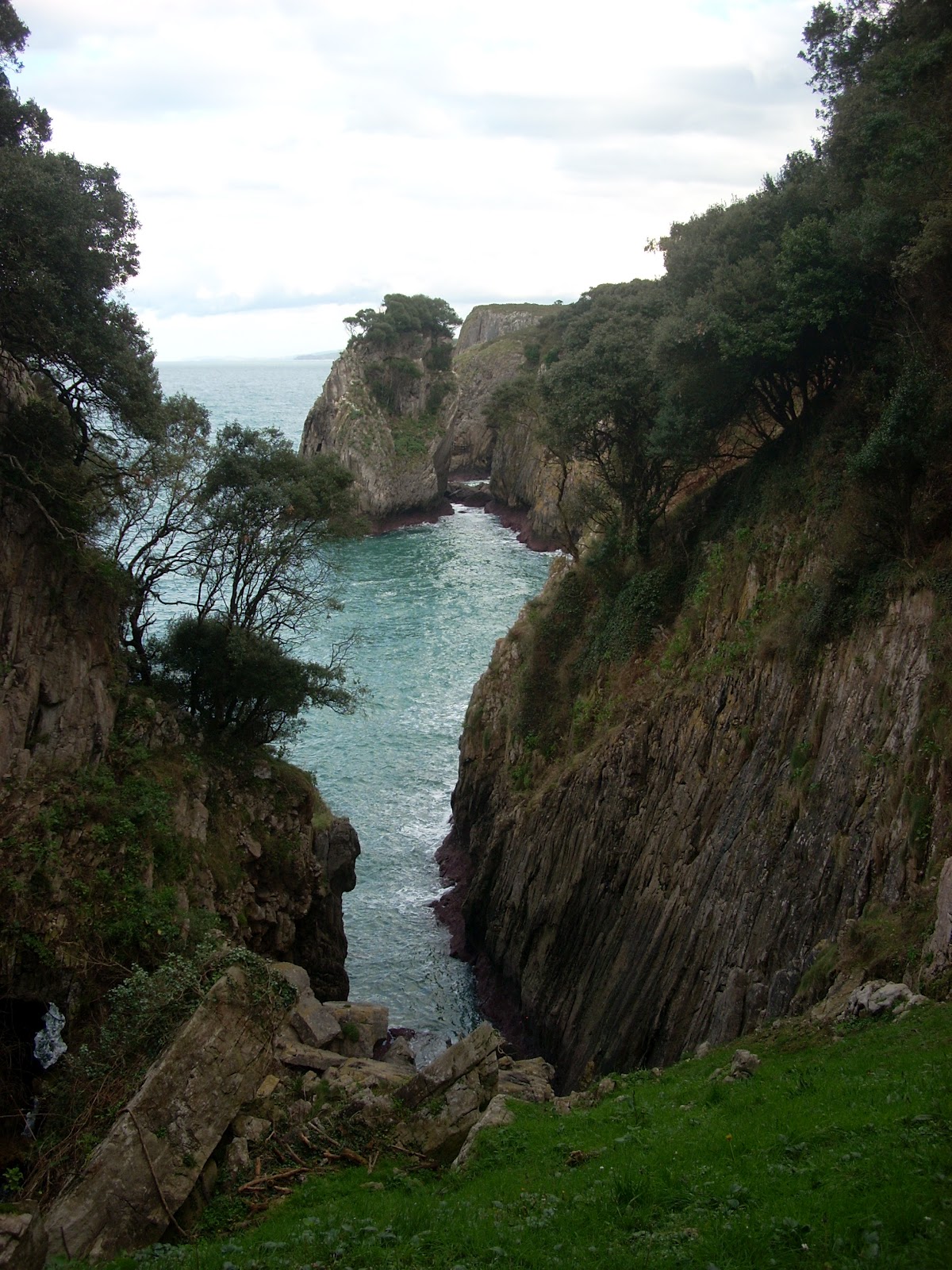
Then we drove just over the border into Asturias, where we drove up a hill to a tiny resort village at the top of a ridge overlooking the sea. Since we had time to kill before our cave appointment, we went to a lookout and took a brief walk down a very steep hill leading down to cliffs, and eventually to the ocean. The sun was coming out from behind the clouds, and even though the water here is far from tropical, it always has that turquoise tinge to it that I associate with much warmer climes. I snapped a few pictures of my friend Leah venturing down in front of us, and got this one of the sun shining full on her. I love the way her little red hat makes her stand out in the vast landscape she's a part of. I am no photographer, and my camera is a piece of crap, but sometimes by sheer luck a nice picture gets produced.


The cave was down the hill towards the sea. We walked through a forest of stunted trees with gnarled roots coming up out of the ground, and down a narrow staircase carved into the cliff on the other side. 


It opens up to a view of the ocean, a very Pirates-of-the-Caribbean scene with a huge rock that looks like it grew right up out of the ocean.


The cave tour was just the four of us with the guide, and we walked deep into the cave, along wet, dripping paths that wound between thick stalagmites. It was mostly dark and muddy in the cave, but the guide turned on low lights and carried a flashlight so we could see the drawings and carvings he pointed out on the walls. I've been to a number of caves in this part of Spain, some with drawings, some with incredible rock and crystal formations. I never get tired of seeing the drawings on the walls, and imagining the people who made them. Twelve thousand years ago. Twelve thousand. You know Christ? How he lived two thousand years ago? Yeah, go back another ten thousand from then. These people lived in caves, but not this one, because it opens directly onto the ocean and is very cold and wet. But they went deep into el Pindal to paint on the walls with an iron oxide compound they mixed with animal fat; that made the lines absorb into the porous rock, so that they haven't faded over time and are just as vibrant (the experts think) as they were back then. The people -- probably the shaman or holy men, but no one knows for sure -- painted bison and horses and, as I mentioned above, a fish and a mammoth. They used the rock itself as part of the drawings, so that the heads of some of the drawn bison protrude like the real animal, or the curve of a horse's haunch is clear in a crack in the stone. 


There are also abstract marks that can be found in caves all over the north of Spain and into the south of France; scientists think they could have been some kind of mutually understood communication system between the many tribes that used the network of caves along the coast of the Bay of Biscay, or that the tribes shared a religion and the marks represent some spiritual meaning. It's incredible that modern man can know so much about these ancient people, but there is still so much we'll never know, and it's so thrilling for me to imagine what it could have been like. What the people were like, what they wore, what they looked like, how it felt to live so very long ago. That's one of the things about Spain that make it so mysterious and awe-inspiring -- the ancient, ancient history that surrounds us every day here, that can be seen just about anywhere, and the influence it's had on the way we live now.

As we left the cave not too much happened: one friend and I went into the woods in lieu of a bathroom; I almost lost one of the beautiful green mittens my Granny gave me years ago; and a woman with a siamese cat on a leash came to ask for information about the cave:


The cat was really unhappy about being on a leash and didn't really seem to understand that he was supposed to walk along with the woman -- so mostly she alternated between holding him like a limp ragdoll or heaving on the leash while he dug in his claws and wailed.

We stopped for a drink in Llanes, a pretty little beach town just before the border of Cantabria, and took a walk along the sea wall as the sun set behind the mountains opposite the ocean. 


We wanted to get a snack in Llanes, but nothing was open, so we moved along from town to town looking for a bar whose kitchen was preparing food. All we found was a rest stop off the highway, where we ate potato chips. Then we drove home. Just a normal end to a normal weekend day trip. You can see more pictures here.


Monday, January 23, 2012

Metiendo la Pata

"Meter la pata" in Spanish means "To put your foot in it." According to the Mac dictionary on my computer, this means the same thing in English, with the variation "Put one's foot in one's mouth." (I had to look it up because my English has become tainted after so many years of existing in two languages simultaneously and constantly flip-flopping between them). This new tag is for incidences in which I embarrass myself in one way or another -- "meter la pata" -- and it's a little bit sad that a whole tag can exist for this...but I do it often enough, or embarrassing situations arise often enough, that it deserves its own category. Hey, if you can't laugh at yourself...life is really not funny? I don't know how that saying is supposed to end. Living abroad has made me take myself much less seriously, so I will continue to add embarrassing anecdotes so my readers will also take me less seriously. Ha.

Thursday, July 14, 2011

Friday, February 26, 2010

Video Postscript: Revelry in Toro

After our concert we were treated to a dinner above the theater with all the other performers - it was a community concert in honor of St Cecilia, so the local guitar orchestra played with a guest flutist, a funny little man sang funny little songs, and afterwards we all ate and drank and everyone sang. It reminded me of music parties at our house, or some of the festivals we went to when I was younger - with alcohol and good times come the traditional songs that everyone knows and spontaneously begins to sing. It was so great! 

(Keep an eye out for the Spanish Old Ladies in their fur coats and full makeup)
 

Friday, December 12, 2008

Get the Spaniards out of My Grill; or, Misadventures on the Santander Bus System

as my trip home approaches, i'm realizing how ready i am for a little break from spain. i truly love it here, and am considering extending my contract to teach for another year. but there are certain things i miss about the US, and certain things about spain that drive me absolutely nuts.

for instance, there is the personal space issue. the spanish "bubble" is much, much smaller than the american one. in fact, i'd go as far as to say it does not exist. people are all up in your grill, all the time. the other day i was waiting for a friend outside a supermarket downtown. i was waiting about a yard from the door, against the wall of the bulding, on a sidewalk that happened to be mostly empty. a woman came along, approaching the supermarket entrance, and actually
ran into me on her way inside. as in, hit my shoulder with her shoulder, and even gave a little huffy sigh of exasperation. ARE YOU KIDDING ME? the whole sidewalk is EMPTY. i am not in your way by any means. and she ran into me 3 feet from the very wide supermarket door?? i was so mad!

the day got worse. later that night i had choir rehearsal, which takes place up on a street called General Davila, which is the worst street in the whole world. perhaps that is a slight exaggeration. but i really hate it. it's at the top of a huge hill, so walking from either direction means hiking a 45 degree slope, and of course it's usually pouring rain. it's a long, ugly, dark street. there is only one bus that goes there, the number five, and by association it is the worst bus in the whole world. it is always packed full of people, and sometimes it doesn't even stop because it's so full. then you have to wait another 15 minutes in the rain at the tiny bus stop full of too many people smoking cigarettes in your face.
General Davila is a very residential street, so the buses going there are always in high demand. as the little digital screen counts down the minutes we have to wait, people start to get more and more restless, shifting over to where they're guessing the bus doors will open so as to be the first one on. which in the first place is stupid, because if the bus driver stops he's not going to pick and choose who can get on. and secondly, it is super annoying because people are wicked pushy and a little mob crowd forms while 15 people try to squeeze through one bus door at the same time, all wildly waving their bus passes and their one euro coins. and inevitably there is that one little old woman who pushes through everyone and stands in the bus doorway to ask "are you going to valdecilla?" 75% of the time they are not, so she fights her way back through the crowd. (the little old ladies are the WORST with the pushing and shoving and general lack-of-respect-for-personal-space. it's the little old ladies who'll getcha).

so as i reluctantly joined the mob that monday evening, a little old lady (told you) bumped into me pretty hard. i turned around, uselessly, because they never acknowledge it. but this time, miraculously, she apologized profusely, calling me "hija," which means "daughter" but is more like "sweetie," saying she was so sorry, oh pardon me, i'm so sorry, excuse me please, forgive me. i turned back around, feeling wonderfully surprised and pleased with this showing of politeness from a spaniard. i was shuffling towards the door, looking over all the short, bald people in front of me (everyone here is bald and short. both men and women. maybe bald is a strong word; but hair-loss is rampant here), when i felt something poke me very forcefully. it was the woman who'd apologized for bumping into me! she had her finger in the small of my back, and was physically
pushing me into the people in front of me so she could get on the bus faster! she was bossing me verbally too, saying "get on, get on, hurry, move forward, that's it," all the while pushing me and poking me. i couldn't believe it. right then and there my slightly renewed faith in spanish manners was crushed under the wheels of the number five bus by a pushy old spanish woman in an ankle-length fur coat and hot pink lipstick. needless to say, the number five bus has not improved any since then. nor has General Davila. although to be fair, last night my trip up there was relatively uneventful.

i realized that the lack of manners (or what we in the US would consider manners -- obviously here it's not really considered a social a transgresion to push people onto buses) is taught from a young age. i teach a private 'class' to two little girls, who are four and five years old, respectively. yesterday i had them say "por favor" when they asked me to open the door for them, or when they grabbed markers out of my hands, and they looked at me like i had three heads. and my roommate's boyfriend chews with his mouth open. smack smack smack. i guess the branch-spencer household and road's end farm emphases on manners has stuck with me in a big way.

but soon i will be home in the land of cool (frigid?) northeastern attitudes, where strangers don't touch each other, where (most) people (i hope) chew with their mouths closed and say "please" when they want to use the blue marker. i fly home december 19th (a week from today)! although let's be honest, the moment i land in boston i'll wish i was back here. but c'est la vie, right? the grass is always greener.


Friday, October 17, 2008

An Observing Adventure. Or, The Old Man and the Octopus

today i went down to Puerto Chico, a big long pier along the bay where people go to walk ("dar un paseo"), ride their bikes, sit and read, meet friends, fish, etc. The fishing part is what we're dealing with here.

i brought my journal, and was sitting having a lovely time writing, looking out over the water at the mountains on the other side, with the sun going down over to my right behind some spectacular gray-blue clouds. i saw lots of dogs and had serious pet envy. a fat woman dressed head-to-toe in purple came and sat on the bench behind me and filed her nails for a long time.

there were lots of men fishing -- every few yards was another guy with a long fishing rod, sitting on the big metal things they tie boats to. the one closest to me was a tall old man with a tweed golfer's hat -- the kind the farmer wore in "babe." he looked lonely, sitting there with his fishing rod, just quiet and patient. all of a sudden his rod bent down in a big curve -- such is the sudden excitement of his chosen sport! some kids on bikes wheeled over to see what was going on, and quickly a small crowd formed. i of course couldn't resist joining, so i hurried over to the line of people all leaning over at the same angle to look along the pier at the commotion. a neighboring fisherman ran over with a big round net at the end of a rope. a murmur came down the line of anxious obvservers -- "es un pulpo! ha enganchado un pulpo!" ("it's an octopus! he's caught an octopus!") the man next to me said surely the guardia civil (civil police officially, but much, much more to spaniards) were on their way to charge him up to 200 euro; although fishing octopus cannot be illegal here, i've seen enough droopy, gelatinous carcasses in fish markets to know that for sure. i later asked my roommate and she said it's illegal to catch them off the pier. but that octopus must have known, because he was holding on so hard under the water -- i didn't see it, i never saw it come above the surface. but that old man was pulling and pulling, and the octopus was not having any of it. secretly i was rooting for the slimy guy. i could just see him with every little suction cup hanging on to the pier for dear life...they're supposed to be very, very smart. poor little (big! he must have been big) guy. finally, at the height of the struggle, SNAP! the fishing line broke. the octopus was victorious. i cheered inside. the crowd dispersed quickly -- nothing more to see with a broken fishing line and an octopus that was surely hightailing (hightentacling?) his way out of there. the kids on the bikes were the last to leave, lingering to chat with the old man, i think hoping for a relapse of excitement. but soon they drifted away as well, leaving the little old man by himself again. he sat back down on the bollard (i looked it up -- the things you tie big boats to), with his rod re-baited and ready. although i think he sat a little straighter this time.